



mis à jour le Jeudi 22 janvier 2026 à 18h26
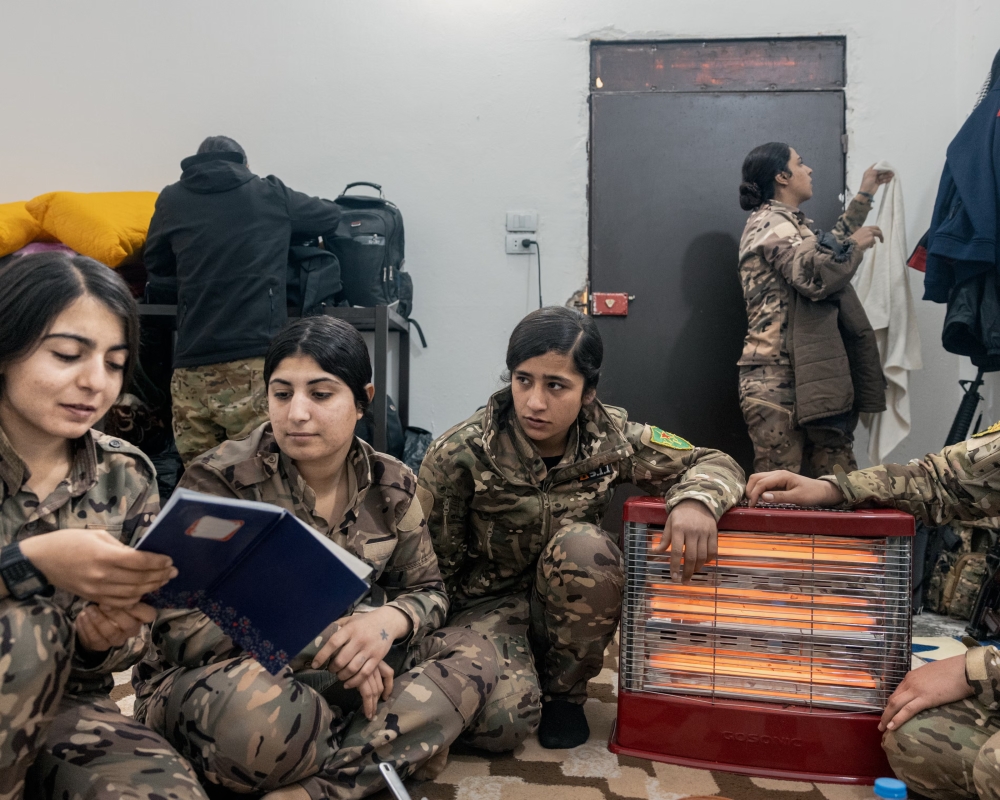
Women’s Protection Unit (YPJ) fighters at a military academy in al-Hasakah, Syria, in December 2024.
Photograph: Elke Scholiers/Getty Images
Theguardian.com
For a decade, the autonomous territory in Syria has been a bastion of gender equality. It holds important lessons for the fight against authoritarianism
A year ago, I was in north-east Syria, in the Kurdish-dominated area known as Rojava, listening to some of the most determined women that I have ever met. On my first day there, I went to a huge conference where one after another, women in Kurdish, Arab and Assyrian dress roused the audience to chants of “Jin! Jiyan! Azadi!” (Woman! Life! Freedom)!.
When I visited, this region of Syria had for more than a decade been governed not by Bashar al-Assad’s regime, but by an autonomous administration (the Democratic Autonomous Administration of North and East Syria, or Daanes). Its commitment to equal rights has been remarkable – every institution it set up relied on power-sharing between men and women. No wonder many of the women I met there sounded optimistic about their future. “This will be a century of women’s freedom,” one said to me. “We are in solidarity with women in resistance throughout the world.”
Now, I’m getting messages from these women that speak of their despair. They say the future is dark. They speak of betrayal by the west. They say they face slaughter.
This autonomous region is being throttled, as the Syrian government, led by Ahmed al-Sharaa, is trying to bring the whole country under its control. The Kurds in north-east Syria are right to fear what that control would look like: massacres of other minorities, including Alawites and Druze, have taken place recently elsewhere in the country. Al-Sharaa, with his background in al-Qaida and desire for a centralised national government, represents the polar opposite of the secular, decentralised ideals of the autonomous administration.
As government forces advance, the territory controlled by the administration has already shrunk dramatically. Those parts of north-east Syria where Kurds are not in the majority have slipped away, and even the key Kurdish areas are under threat.
The messages that I’m receiving from women in Rojava are heartbreaking. But they are also speaking of their ongoing determination to defend the achievements of north-east Syria. Nobody should dismiss their determination as mere talk. The region’s armies, led by the Kurdish-led Syrian Democratic Forces (SDF) and including the Women’s Protection Units (YPJ), the women’s army, fought to destroy Islamic State.
As I write, a patchy ceasefire is holding and the administration’s spokespeople state they still hope that negotiations might bring about a settlement that preserves the rights and freedoms of the Kurds and other minorities. But there is no glossing over the fact that the future for the region looks bleak. And what happens there matters well beyond its shifting borders. Because Rojava has long had the power to inspire beyond its territory.
Many anarchists and socialists have been galvanised over the years by the administration’s stated commitment to try to create a bottom-up, decentralised political system. For sure, the administration often struggled to put these radical ideals into practice. Human rights abuses and repression of dissent were still reported; many Arab people in the region reported that power was, in practice, held only by the Kurds. It is important not to romanticise Rojava and to recognise that gaps existed between rhetoric and reality.
But where its ideas worked out, they were transformative. They ensured decisions were taken closer to the ground, by those directly affected – whether that was the distribution of food in a displaced people’s camp or the reformation of the legal system with an emphasis on restorative justice.
Meanwhile, the administration’s commitment to gender equality was clearly building a true counterweight to patriarchal practices. The feminism I found there was not the same as western feminism. Kurdish women drew inspiration from their own traditions – from ancient Mesopotamia to women’s participation in Kurdish struggles throughout the region.
The intellectual confidence among the women I met struck me hard – and I don’t mean just the writers or teachers. I mean all the women: from soldiers to judges, from women working in a textile factory to those on an agricultural committee. They were rereading feminist writers from Nawal El Saadawi to Virginia Woolf, Sakine Cansiz to Rosa Luxemburg, taking their ideas apart to see what they could use in practice, examining the limits of western liberalism when it came to women’s rights, and how feminism and socialism could work together.
This energetic reforging of the theory and practice of feminism couldn’t be more alien to the forces that are now confronting Rojava. All the powers that are rising around the globe right now, from Donald Trump’s US to al-Sharaa’s Syria, from Recep Tayyip Erdoğan’s Turkey to Vladimir Putin’s Russia, are ready to trample women’s rights underfoot alongside their disregard for democracy.
The question of how people can build a counterweight to growing authoritarianism has never been more urgent. Women and men in north-east Syria have been putting their energy into trying to answer that question for years. And now it’s up to all of us who admired that energy to think about how we can show solidarity. That can involve using our voices to pressure our government to support the rights of women and minorities in the region, and to rein in the Damascus government’s repressive ambitions. It can involve engaging with the ideas and practices of direct democracy that characterise the region’s governance at its best. And it can also involve trying to build a more collective and confident feminism in our own societies.
Natasha Walter is the author of Before the Light Fades and Living Dolls: the Return of Sexism