

Wednesday, 1 April, 2026 , 18:55
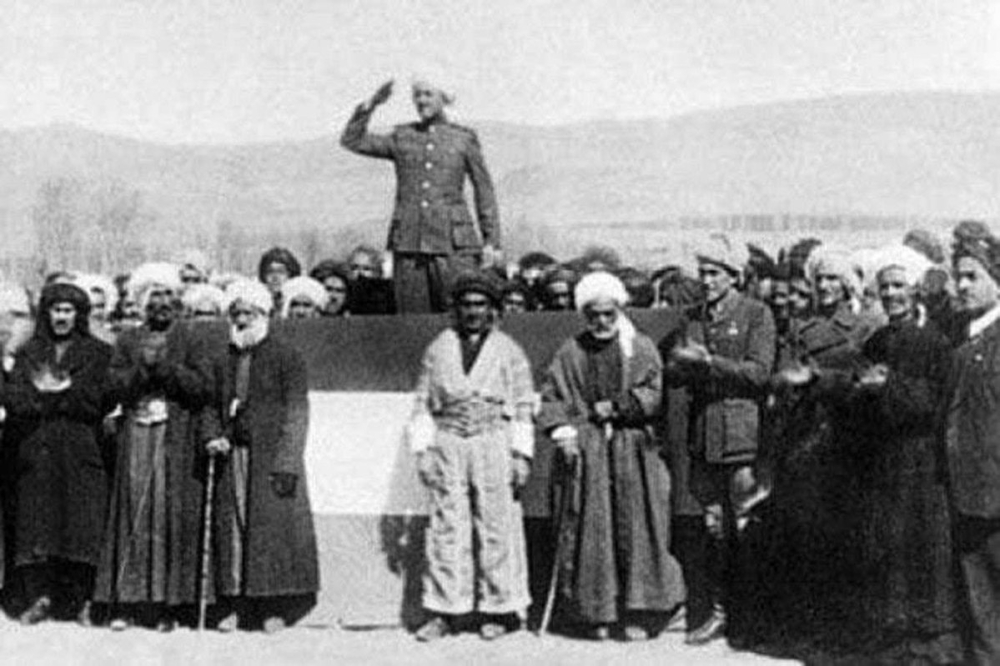
Proclamation of the Republic of Kurdistan, January 22, 1946, in Mahabad by Qazi Muhammed.
In the front row: General Barzani
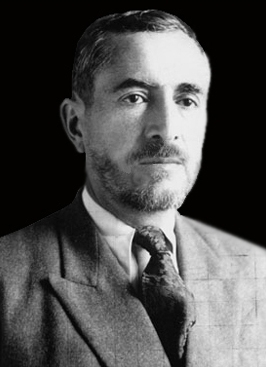
Qazi Muhammed
(May 1, 1893 - March 31, 1947)
Seventy nine years ago, on March 31, 1947, the president of the short lived Republic of Kurdistan, Qazi Muhammed, his Minister of Defense Seyfi Qazi, and his brother Sedrî Qazî were executed by hanging by the Iranian monarchy on Çar Çira Square, meaning Four Torches, in Mahabad, the capital of this republic.
The Republic of Kurdistan had been proclaimed on January 22, 1946 in Mahabad, in a part of Iranian Kurdistan located between the Soviet occupation zone in the north and the British zone in the south, which had escaped the control of the Iranian government. In a Middle East dominated by despotic monarchies, the Kurds took the initiative to proclaim a republic, which quickly generated patriotic enthusiasm across Kurdistan. The Iraqi Kurdish leader Moustafa Barzani crossed the border with thousands of fighters to place himself at the service of this republic. He was appointed commander in chief in charge of defending the young state, led by a learned, respected and progressive judge, Qazi Muhammed.
The Republic adopted the Kurdish flag, composed of red, white and green stripes with a yellow sun with twenty one rays at its center. This flag had previously flown from 1927 to 1930 on Mount Ararat, in a liberated area during the Kurdish uprising led by Ihsan Nouri Pasha against the Turkish Kemalist regime. The Republic also adopted a national anthem, Ey Reqîb, meaning Oh Enemy, composed by an Iraqi Kurdish poet. This flag and anthem are today those of the Kurdistan Region and, beyond that, symbols for all Kurdish patriots. The name Peshmerga, meaning those who face death, was introduced by the Republic to designate its self defense forces. The first modern Kurdish political party, the Kurdistan Democratic Party, was founded by Qazi Muhammed.
From its inception, the Republic of Kurdistan made education and the emancipation of women national priorities. An exceptional cultural, scientific and artistic revival marked the short life of this republic, which was invaded on December 17, 1947 by the Shah’s army.
General Barzani advocated armed resistance, but President Qazi Muhammed, realistically assessing the new balance of power against a monarchy now supported by both the Soviet Union and the United States, chose not to expose the civilian population to massacre. General Barzani, together with 500 of his most loyal peshmerga fighters, then began a long march of more than 700 kilometers across the borders of Iraq, Iran and Turkey before swimming across the Araxes River to seek refuge in the Soviet Union. After a brief stay in Azerbaijan, they were deported to Uzbekistan, where they remained until 1956.
In 1959, following the overthrow of the Iraqi monarchy by General Abdul Karim Qassem, they were able to return to Iraq, where they were welcomed as heroes of the resistance by the leader of the new Iraqi regime, whose mother was Kurdish and who promoted Kurdish Arab fraternity.
Qazi Muhammed remained in Mahabad with his relatives to assume his responsibilities toward his people. He was arrested and, after a summary trial, sentenced to death and executed alongside his Minister of Defense and his brother. Courageous and dignified until the very end, earning the admiration of his people and even of his executioners, Qazi Muhammed declared: “You execute me today, but know that the Kurdish people are alive, and there will be thousands of Qazi Muhammed to continue their struggle for freedom.”
Çar Çira Square in Mahabad has become a central place of Kurdish collective memory. Qazi Muhammed, known as Pêşewa, meaning the leader, has entered the pantheon of Kurdish patriotism and is revered across all parts of Kurdistan.
In his final message, he called on the Kurds to set aside their internal divisions and unite in a common struggle for the freedom of Kurdistan. This message remains as relevant as ever, just like his call to prioritize education for both boys and girls in order to build a modern and educated Kurdish nation, capable of defending its rights and living freely on the land of its ancestors, in peace with its neighbors.
We salute the courage, progressive and democratic vision, and the memory of Qazi Muhammed, who remains a leading figure of the Kurdish national liberation movement and a source of inspiration for the Kurdish people.